
Leo Butler: All of life’s dramas
by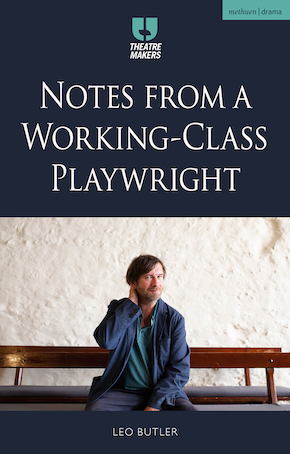
IF THERE WERE AN IKEA for playwriting – where you could easily pick up everything needed to engage an audience with what’s happening on stage – you would still need an instruction manual to assemble all those brilliant ideas of yours. In his new book Notes from a Working-Class Playwright, award-winning Leo Butler painstakingly explains that not only is there no how-to guide for writing a play, but that successful plays could not be further removed from IKEA furniture. In fact, they are its complete opposite: they resist standardisation and reject comfort.
That uneasy feeling you get when, after three hours on your hands and knees, you finish assembling the furniture and notice a leftover nail – that same sensation can strike after just two lines from one of Leo’s plays. Only then, what you realise is wobbly is not a wardrobe, but the status quo of the world.
Leo Butler’s work circles the fractures of contemporary life – power, intimacy, failure, desire – and presses on them until something uncomfortable, and unmistakably human, breaks through. A playwright unafraid of silence, excess or moral ambiguity, he treats the stage as a place of exposure rather than escape. He does not fear rejection – courting it, even, as part of the work’s necessary risk – and he is brutally honest about what that risk costs. As a dramaturg and playwrights’ tutor, he brings his uncommon generosity offstage too: he gives time, attention and space with equal care. He meets his students as he meets his audience: as equals, trusting their intelligence, curiosity and capacity for complexity. This ethos is distilled in Notes from a Working-Class Playwright, part practical guide, part memoir, written from the conviction that he cannot separate his life from his work. Drawing on a decade of mentoring an army of then-unknown playwrights soon to be big names at the Royal Court, the book lays bare how plays are made for those who have had enough of Aristotle’s definitions and haven’t had the good fortune of attending his classes.
In this conversation, we talk about what theatre is still capable of when it refuses politeness, the risks of writing without safety nets, the politics of intimacy, and why discomfort may be the most honest form of connection between playwright, student and audience.
—
Alexandra: In the book you are brutally open about your personal hardships, bullying, drug-taking extravaganzas, etc. Is honesty always a playwright’s starting point?
Leo: I suspect that even if you’re writing a play that’s historical or science-fiction (not based on your own experience) then there will always be an element of yourself in the characters and story, whether you like it or not. Like a good actor, if you can find a personal connection with the stories you write it will give them authenticity and – for want of a better word – juice. What’s the point of not being honest?
You have stated that all your plays start with an image in your head. How can you tell which ones will turn into a play?
I try to write as if I’m sitting in the audience watching it play out in real time. It’s exciting when a stage image reveals itself in your imagination and you just know it belongs in the play somewhere. However, if an image or moment doesn’t serve the story, then it may end up on the cutting-room floor. And you can save it for another play.
Is writing a play a course of a million small choices, or is it like Michelangelo said about sculpting: “you just remove the parts of the marble that are not David”?
At the beginning there are definitely a million choices – which is why I try and find a structure early on to give myself some restrictions. How many scenes, characters, how many locations, over what timescale, etc. Giving yourself restrictions opens up more creativity than having no restrictions at all. I like the Michelangelo quote! Yes, that’s very true of rewriting – once you’ve got a first draft and you’re smoothing it out, improving it. To begin with you’re throwing paint at the walls, but then you have to work out who or what you’re looking at and remove those parts that maybe belong to another story.
If you want to be an artist, you’d better get used to rejection… You must stumble on and persevere and, where you can, put yourself in a position where rejection doesn’t matter.”
What is the greatest barrier between the audience and the stage?
Bad acting. A bad production. Mobile phones. Rustling sweets or crisps. People chewing gum or getting up to go to the toilet. Why do people feel they have to drink alcohol when watching a play? You don’t take a can of lager into a gallery.
Alice Munro said that she could plaster her wall with rejection notes from The New Yorker. How can an artist cope with rejection?
If you want to be an artist, you’d better get used to rejection. It will happen throughout your career – sometimes it will have financial implications or affect your mental health, which is never easy. But you must never believe it’s about the work, or tell yourself you’ve created something bad. You must stumble on and persevere and, where you can, put yourself in a position where rejection doesn’t matter – as in, make the work yourself.
Sophocles, Shakespeare, Brecht. Why does the world need new plays if the classic ones tell us all we need to hear?
If the same circus rolls into town, the people will go to the beach.
If we could slap people instead of putting on political plays, do you think we should go for it?
Someone will slap you back. It’ll be a slap-fest. No one benefits or learns anything from a slap. I’d rather Tony Kushner’s Angels in America, Caryl Churchill’s Far Away or Dario Fo’s Accidental Death of an Anarchist any day of the week.
Christopher Marlowe was stabbed, and now there is a beautiful theatre named after him in Canterbury which rarely produces his plays. What shall the rest of us expect?
I’m sure Marlowe would have sacrificed every word he ever wrote not to be stabbed. I doubt – wherever he is now – he cares whether there’s a theatre named after him or not. Expect never to be performed, re-staged, evaluated, or for your work to have any impact on the world today or on future generations. If you’re writing for posterity or influence you’re just shooting yourself in the foot.
According to Yuval Noah Harari, gossip has evolutionary value as it enables us to build trust and understanding beyond our small groups. Are playwrights the professional gossips of society?
I understand the quote, but I don’t think ‘gossip’ is accurate. Some playwrights are just entertainers. Every play is a fairground ride – I like to think of some of my plays like a hall of mirrors. I’ve occasionally tried writing a ghost train or a rollercoaster.
Many now famous playwrights used to be your students. What’s your advice for when they realise that they are not Shakespeare?
The world needs new playwrights more than it needs Shakespeare. I’m sure Shakespeare would agree.
You are very generous as a teacher; in the book you even give away your teaching plan and suggest an idea bank where everyone can contribute unused ideas to be picked up by peers. Is writing mostly an act of generosity?
In some ways, it’s an act of stupidity. There’s little or no money in it. All that time on your own when you could be doing something more interesting or, indeed, generous. However, even if you’re shedding light on characters who are despicable, or sharing a worldview that is pessimistic, that itself is an act of generosity.
Is it true that in chapter 7 you use Laurel and Hardy to give advice on how to climax?
Depends what kind of climax you’re referring to. Dramaturgically, yes. We can learn everything we need to know about telling stories from those fabulous Laurel and Hardy short films. Some of them are as good as anything by Samuel Beckett or Ionesco.
The live theatre experience will become more necessary and longed for as we drown and lose contact with each other in the virtual world. The trick is to make sure the theatre programmers still take risks.”
One of your mantras is “throw shit at the characters; things must always get worse for them, even when they get better.” Are successful playwrights resourceful sadists?
You can’t be easy on yourself, and you can’t be easy on your characters, so a bit of sadism and a bit of masochism are both helpful. Name me one good drama where things go well for the characters – until maybe the end of the story. If things go well, it’s only temporary. There’s a very funny play by Swedish playwright Joakim Pirenin – The Good Family – that demonstrates this. In the play, only good things happen to the family, and if there’s a crisis, the family deal with the crisis kindly and successfully.
Kurt Vonnegut famously said that an artist is like a canary in a mine, capable of sensing long before anyone else the potential for a collapse or an explosion. Is this selfless artistic sensitivity what we call talent, or is talent something completely different?
Good quote. If we’re not closed off, we can all sense the potential for danger in our own lives and the world around us. Talent is just the individual’s own natural (or peculiar) mode of expression. Everyone has talent.
Tolstoy preferred Chekhov’s short stories to his plays – and even though no one asked, so do I. How can we tell which opinions we can make use of?
Whichever one puts a spring in your step.
Theatre is an embodied experience. Do you think it could be an antidote to social media’s bodiless outpourings?
Far from being dead, the live theatre experience will become more necessary and longed for as we drown and lose contact with each other in the virtual world. The trick is to make sure the theatre programmers still take risks, still keep holding a mirror up to our lives – even when we don’t like what we see.
In the end, everything – from reviews to awards, and from boring meetings to interviews – is noise that can make us forget the joy of being part of a play. How can we hold on to this joy?
The most joyful aspect of theatre is the participation with other people. Everyone should have the experience of putting a play on at some point in their lives. The noise is just noise.
—
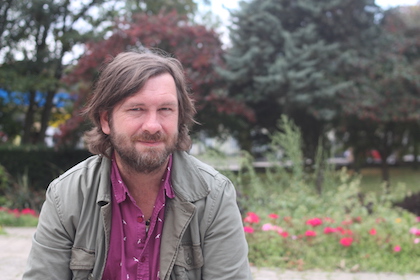
Leo Butler’s celebrated plays include Made of Stone (Royal Court), Redundant (Royal Court, winner of the George Devine Award), Boy (Almeida), I’ll Be The Devil (RSC/The Kiln), Lucky Dog (Royal Court), Faces in the Crowd (Royal Court), All You Need is LSD (Birmingham Rep/Told by an Idiot) and Innocent Creatures (National Theatre). For ten years, he was Writers’ Tutor at the Royal Court and helped nurture a new generation of playwriting talent. He is currently Dramaturg of The Marlowe Theatre, Canterbury. His new play, Living, produced by Sheffield Theatres, runs at the Tanya Moiseiwitsch Playhouse from 14 March to 4 April. Notes from a Working-Class Playwright is published by Methuen Drama.
Read more
instagram.com/mrleobutler
instagram.com/methuendrama
@leobutler.bsky.social
@methuendrama.bsky.social
sheffieldtheatres.co.uk/events/living
Alexandra Samothraki (born 1980 in Athens) holds a MA in Publishing from City University and a Diploma in European Theatre from the University of Kent. She was named Best Young Playwright in 2011 by the National Theatre of Greece for her play Jasmin Lair, and has been the UK correspondent of literary portal Anagnostis since 2011, writing opinion pieces, book reviews and interviewing the likes of Yoko Ogawa, George Saunders, Terry Eagleton and Juan Mayorga. Her crime novel Weighting of the Souls was published in Greece by Isnafi Publishing, and her English translation of Giannis Paschos’ Chronicles of a Dyslexic Author is published by Stairwell Press. She lives in Canterbury.
Read Alexandra’s interview with Giannis Paschos:
Not necessarily in the right order


