
The nail in the wall
by
IT WAS SUNDAY. MÓNICA WANTED to hang a picture on the wall, a small Walter Lazzaro reproduction, and I didn’t want to. The wall wasn’t actually a wall, but one of the four square columns that delineate the perimeter of the room. It’s a narrow column, but wide enough to hang a small picture on it. At first I’d agreed, went for the hammer and pounded a nail into the spot where we both thought it should hang. We really liked Lazzaro’s painting: a fisherman’s boat abandoned on the sand of the beach; there was nothing but the boat and turquoise sea stretching as far as the eye could see. Then someone knocked on the door. Mónica went to see who it was. It was one of our neighbors in the building, and she and Mónica started to talk about a discrepancy with the maintenance fees. I remembered a program I didn’t want to miss, turned on the TV, and sat down to watch it. Mónica had to go downstairs with the neighbor to talk to the person in charge of collecting the building fees, and Lazzaro’s painting was momentarily forgotten on one of the dining room chairs. The column was directly in front of where I was sitting, right behind the TV, and I noticed the nail. It caught my attention because it was right where it needed to be, in the middle of the column. Without using the tape measure, just by eyeing it, we had found its center, in relation not only to the width but also to the height. Well, this isn’t entirely accurate. The nail was near the top of the column, in that area closest to the ceiling where paintings are usually hung. However, in relation to the whole column, it was as if we had found its true center, or rather its heart, and there was something magical about that. It was, so to speak, the ideal spot for a painting, so ideal that we didn’t have to hang anything up anymore. The nail was an excellent substitute for any painting.
When Mónica returned, seeing the Lazzaro painting still on the chair, she asked why I hadn’t hung it up and I asked her to sit next to me. I grabbed her hand. Mónica’s hands are always cold, it could be something hereditary, and when she was sitting down I told her to look at the nail.
“What’s wrong with it?” she asked.
“Don’t you see it? It’s perfect,” I said.
“What are you talking about?”
“The nail.”
She laughed.
“Don’t be stupid,” she said, getting up.
“I’m not joking,” I told her. “We’ve never set a nail so perfectly and the painting’s going to ruin it.”
She realized that I was serious.
“What are you talking about?”
“You’re not looking at it the right way. We identified and then placed the nail on the best part of the column. We don’t have to put anything else there. It looks beautiful the way it is.” She ignored me and grabbed Lazzaro’s painting so she could hang it on the nail.
“No!” I shouted, grabbing it out of her hands.
Mónica looked at me as if I’d slapped her.
“What’s wrong with you? Have you lost your mind?”
I thought that if she hung it, everything would go to hell. Once covered by a painting, the nail would lose its power, so to speak. I tried to explain that to her, but she looked at me in that way that made my guts churn:
“If you aren’t going to hang that painting you’re going to take this fucking nail out of the wall,” and she went into the kitchen and slammed the door. I, having stood up, sat back down, leaving the painting where it was.
It was Sunday, like I said. The worst day for a fight. Later I tried to smooth things out when I asked her if she wanted some tequila. On Saturdays and Sundays Mónica and I have tequila before lunch. Her response was a simple no. I poured one for myself and went back to sit in front of the TV, leaving the Lazzaro painting on the chair.
It wasn’t bothering anyone, it was just a black dot on the column and it produced a sense of fairness, transcendence, and order. Something like an altar. A connection to the cosmos.”
I kept looking at the nail, and every time I looked at it, I had a very clear sense that we shouldn’t hang anything there; that the nail was the painting. It wasn’t bothering anyone, it was just a black dot on the column and it produced a sense of fairness, transcendence, and order. Something like an altar. A secular altar, without crucifixes or devotional images. A connection to the cosmos. Every house should have that, a connection to the cosmos, some way out from inside its walls, the walls that protect you, yes, but they also suffocate you.
It was a difficult Sunday. By the time I went to bed I was exhausted from the effort to avoid crossing paths with Mónica as much as possible in our minuscule apartment.
The next day when she left for the office, we said goodbye with a lukewarm farewell, a sign less of reconciliation than of weariness from having systematically eluded each other during the previous day.
Paulina arrived at her usual time. She started dusting with her cloth and I told her I wanted to point something out to her; I showed her the nail and told her not to remove it for any reason. Paulina is a brusque woman and sometimes she throws away the things she thinks are useless.
“Of course not, señor. Are you going to hang a picture?”
“No, I’m going to leave the pristine nail where it is, that’s why I asked you to look at it, so you don’t think about removing it.”
“Do you want me to dust it?” And she raised her hand to wipe it off.
“No, no, leave it like it is.”
I regretted showing it to her. Now the nail had become something important for her, something to be treated with great care, like my books, and the last thing I wanted was to cast that corner of the apartment in a halo of particular importance.
That night and the following nights, when I sat with Mónica to watch TV, I couldn’t stop looking at the nail out of the corner of my eye, trying to hide it from her, because she’d certainly get angry. Indeed, she noticed.
“Do you have to keep looking at it all the time?” she said.
“What?”
“You know what.”
“Does it bother you?”
“Yes. At least when you’re with me, you could stop looking at it.”
“If Lazzaro’s painting were hanging there you wouldn’t mind if I looked at it.”
“Because a painting is a painting and it’s painted to be looked at, but who would think of looking at a nail?”
“I like it.”
“Well, I hate it!” she exclaimed. “Do you think it’s fun to sit in front of the TV while you stare at a nail on the wall?”
“If I looked at it all the time I’d agree with you, but I only look at it from time to time. Are you going to tell me what I can and can’t look at now?”
She threw the piece of fabric she was holding to the floor and looked at me angrily.
“Okay, since you like nails so much now, I’m going to give you something else to enjoy.” She stood up, walked to the back wall, and began to remove each of the paintings, one by one.
“What are you doing?”
“You’re looking at it: I’m removing the paintings so you can feast your eyes on all the nails.”
“Mónica,” I said, trying not to raise my voice, “don’t be stupid.”
She didn’t answer me. She removed the paintings from the wall, did the same with the wall next to it, and ended up taking down all the paintings in the room.
“There,” she said, “now you can enjoy the view at your leisure.”
I wondered what Paulina thought of that useless nail. Perhaps she had concluded that in spite of all my books, or rather because of them, I was a little off in the head.”
Mónica and I sleep in separate rooms because she can’t stand my snoring. I turned off the TV, got up from the sofa, and went to my room. I started to read, but I was listening for her movements. A while later I heard the TV come on again. I kept reading until I fell asleep.
The next day, after waking up, I went to the kitchen to make myself a cup of coffee. The paintings were on the living room floor, leaning against one of the walls, and you could see the mark each one had left on the other walls.
With the characteristic maneuvering of couples who have been fighting for years, we managed to avoid even the slightest contact until she left for work. My schedule is more flexible than hers, so it’s usually up to me to wait for Paulina to arrive. Mónica had left a message for her in the kitchen asking her to spend the morning cleaning off the marks the paintings had left on the living room walls.
Paulina set herself to the task right away. I was getting ready to leave when she called me over to ask if she also had to clean where the nail was on the column.
“No, Paulina, we haven’t hung anything there,” I told her.
“That’s what it looks like, it’s very clean.”
“Yes, leave that one as it is.”
It was the second time I’d told her to leave it as it was. I wondered what Paulina thought of that useless nail. Perhaps, with the fatalism typical of people like her, she had concluded without any major issues that in spite of all my books, or rather because of them, I was a little off in the head, which must have given her some pleasure, because it reduced the distance that separated us.
As I rode the elevator down I wondered if Paulina wasn’t right. I was a little out of my mind, because who would put a nail in the wall to hang a picture and, after looking at the nail, decide that it looks better without it? What would the Louvre or the Prado be like if they applied the same principle? Excuse me, sir, I can’t find La Gioconda, can you tell me where it is? My apologies, sir, after putting the nail in we saw that the wall looked better with nothing, so we have stored La Gioconda in the basement.
By the time I returned at noon, Paulina was gone. The marks from the paintings in the living room had disappeared. Without them, the nails, without any connection to each other, looked like crushed insects.
Paulina had left a message for me on the living room cabinet telling me that my wife had called to ask me to hang the paintings in their places. I was hungry and went to heat up my lunch. As I ate, I kept looking at the bare walls. Without the paintings, the room had the untidy air of being moved into or out of. I remembered what had happened to a friend when he moved. He was so engrossed in packing up the furniture, rugs, books, and other household items that he forgot to take his paintings. He told me that when he was leaving the apartment and took a last look to see if anything was left behind, the paintings were there, hanging right in front of him, but he didn’t see them, and he attributed it to the fact that, after looking at them for so long, they had all become part of the walls, like the crown moldings and baseboards, which are things no one takes with them when they move out.
I finished my lunch and started to hang them back up. Gradually the walls came back to life. But my doubts began to creep back in. With the larger ones there was no way I could go wrong, but with some of the midsize and smaller ones I wasn’t quite sure where we’d hung them. I had always bragged about my photographic memory and now realized it wasn’t that good. I started trying various combinations to jog my memory about which one went where. I thought it would take me ten or fifteen minutes to hang the paintings, and an hour later I was still there, standing in front of the first wall. I was about to throw in the towel and wait for Mónica to come back. She had taken them down, so now she could put them back. But I thought that if I gave up, I’d be saying she was right, that she had won our little quarrel, because it would demonstrate that her relationship with the paintings was more intimate than mine and that my determination to leave the nail on the column in plain sight was just a whim on my part. So I didn’t give up and continued with my task. After two hours, more because I was tired than out of conviction, I finished hanging them up. And then, as I looked at the bare column, with its nail in plain sight, its magical attraction suddenly ceased, as if hanging all the paintings had put an end to the raison d’être of that single empty space. Standing in front of it, I now saw only a nail thirsty for a painting, like all the others. I resisted at first, but finally went over to the small Lazzaro reproduction. When I hung it I felt my insides turning. It looked spectacular. It seemed to have been painted for that exact spot. I was overwhelmed with profound sadness and I had a premonition that something was gone forever. Something, I don’t know what. That night, sitting in front of the TV, I kept glancing at the lonely boat out of the corner of my eye, at the turquoise sea in the background, and Mónica, of course, noticed. “It’s beautiful, isn’t it,” she said, and with her cold hand she squeezed mine.
from The Shadow of the Mammoth, translated by Curtis Bauer (Other Press, £16.99/$17.99)
—
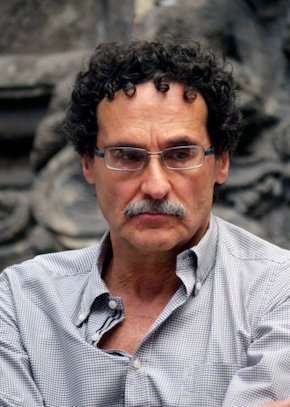
Fabio Morábito was born in Egypt to an Italian family. When he was fifteen, his family relocated from Milan to Mexico City, and he has written all his work in Spanish ever since. He has published five books of poetry, five short-story collections, one book of essays and two novels, and has translated into Spanish the work of many great Italian poets of the twentieth century, including Eugenio Montale and Patrizia Cavalli. He has been awarded numerous prizes, most recently the Xavier Villaurrutia Prize, Mexico’s highest literary award, for Home Reading Service (Other Press, 2021). His short story collection Mothers and Dogs was published by Other Press in 2023. He lives in Mexico City.
Read more
instagram.com/otherpress
Author photo by Pascual Borzelli Iglesias
Curtis Bauer is a poet and translator of prose and poetry from Spanish. He is the recipient of a PEN/Heim Translation Fund Grant and a Banff International Literary Translation Centre fellowship. His translation of Jeannette Clariond’s Image of Absence won the International Latino Book Award for Best Nonfiction Book Translation from Spanish to English. He teaches creative writing and comparative literature at Texas Tech University.
instagram.com/curtis.bauer


